Piano chord · Ninths
D♭ dominant 7th sharp 9 chord on piano
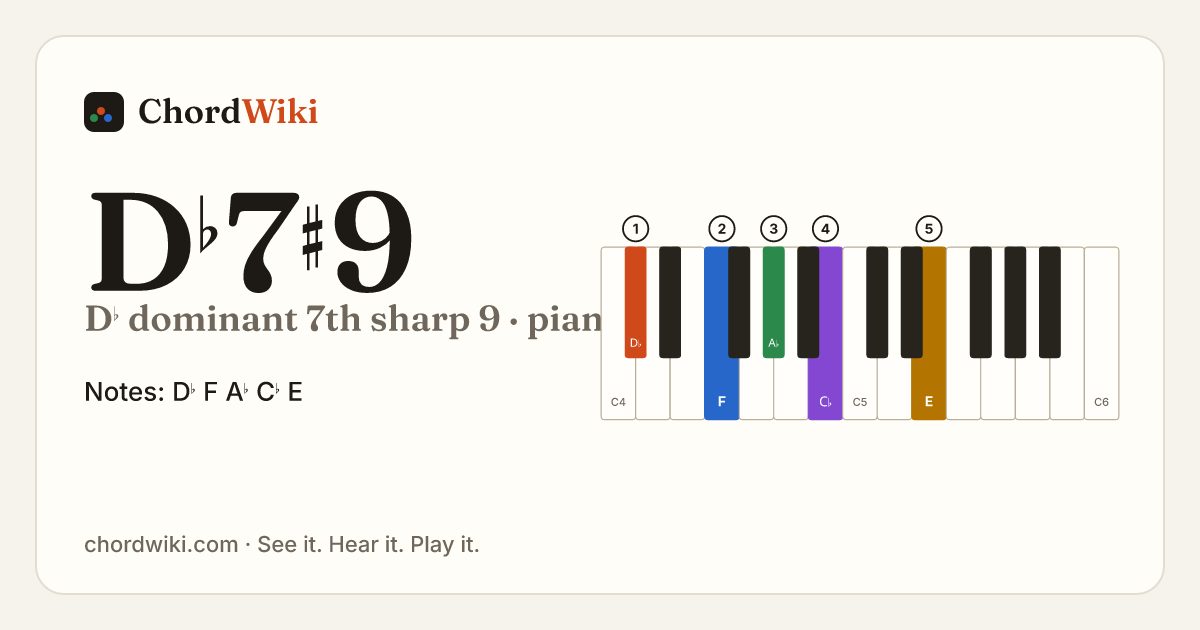
Right hand: D♭ (1), F (2), A♭ (3), C♭ (4), E (5)
How to play D♭7♯9 on piano: the keys to press, which fingers to use, inversions and how it’s written on the staff.
The “Hendrix chord” — gritty, with major and minor 3rds clashing.
- Notes
- D♭FA♭C♭E
- Formula
- 135♭7♯9
- Built from
- root · major 3rd · perfect 5th · minor 7th · augmented 9th
Piano
Root position · numbers are finger numbers
How to play it
Right handD♭1 · thumbF2 · indexA♭3 · middleC♭4 · ringE5 · pinky
Left handD♭5 · pinkythe root, an octave lower
Finger numbers: 1 thumb · 2 index · 3 middle · 4 ring · 5 pinky. Inversions use the same notes with a different one on the bottom — they help you move smoothly between chords. Tap any key to hear it.
Tips for playing D♭7♯9 on piano
On piano, D♭7♯9 has two black keys (D♭ and A♭) and three white keys. In root position it spans more than an octave, so many pianists play the root with the left hand and the rest with the right.
Notice the C♭ in D♭7♯9 (D♭ F A♭ C♭ E): each note of the chord takes its own letter (D–F–A–C–E), so the minor 7th has to be written C♭ rather than B — the same key on a piano, spelled to fit the chord.