Ukulele chord · Ninths
D♯ dominant 9th chord on ukulele
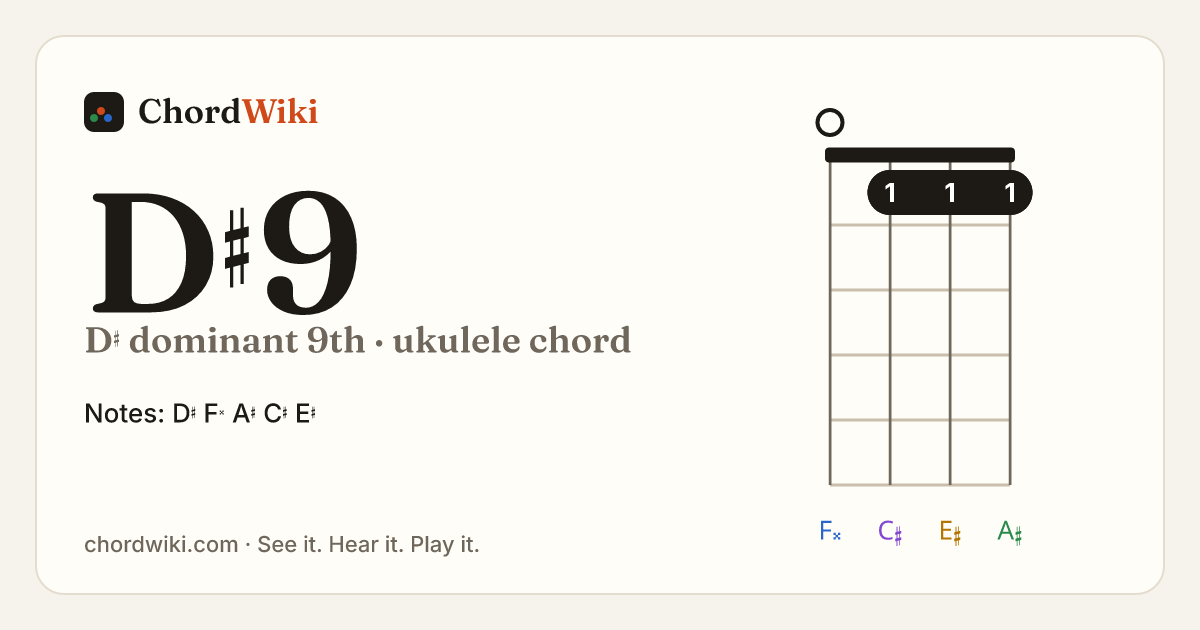
0111 · Open position
All 6 shapes, tab & fingering ↓
6 ways to play D♯9 on ukulele, with finger positions, tabs and step-by-step instructions.
A dominant 7th with an added 9th — funky and full.
- Notes
- D♯F𝄪A♯C♯E♯
- Formula
- 135♭79
- Built from
- root · major 3rd · perfect 5th · minor 7th · major 9th
Ukulele
Standard G C E A tuning · 6 voicings · G string on the left
How to play it · Open position
- Lay your index finger (1) flat across 3 strings at the 1st fret — this is the barre.
- 4th string (G): play open F𝄪
- 3rd string (C): 1st fret, held by the barre C♯
- 2nd string (E): 1st fret, held by the barre E♯
- 1st string (A): 1st fret, held by the barre A♯
Tablature
A|--1---|
E|--1---|
C|--1---|
G|--0---|
Top line is the A string. x = don’t play, 0 = open string.
Every D♯9 note on the ukulele neck
Bright dots are the selected voicing — the rest are other places you can find the same chord tones.
Tips for playing D♯9 on ukulele
On ukulele the usual D♯9 shape is 0111, with a small 3-string barre at the 1st fret. It leaves out the root, which a bass player (or your ear) fills in.
Notice the F𝄪 in D♯9 (D♯ F𝄪 A♯ C♯ E♯): each note of the chord takes its own letter (D–F–A–C–E), so the major 3rd has to be written F𝄪 rather than G — the same key on a piano, spelled to fit the chord.