Triads
B♭ major chord
Bright, stable and resolved — the foundation of most songs.
B♭ is the I chord in B♭ major, IV in F major and V in E♭ major. In minor keys: III in G minor, V in E♭ minor, VI in D minor and VII in C minor.
- Notes
- B♭DF
- Formula
- 135
- Built from
- root · major 3rd · perfect 5th
How to play B♭
About the B♭ major chord
B♭ major is a home key for concert bands and brass (trumpets and clarinets are pitched in B♭) and very common in jazz and gospel. For guitar and ukulele players it’s usually the first barre chord they meet, since it’s the IV chord in F.
Playing it
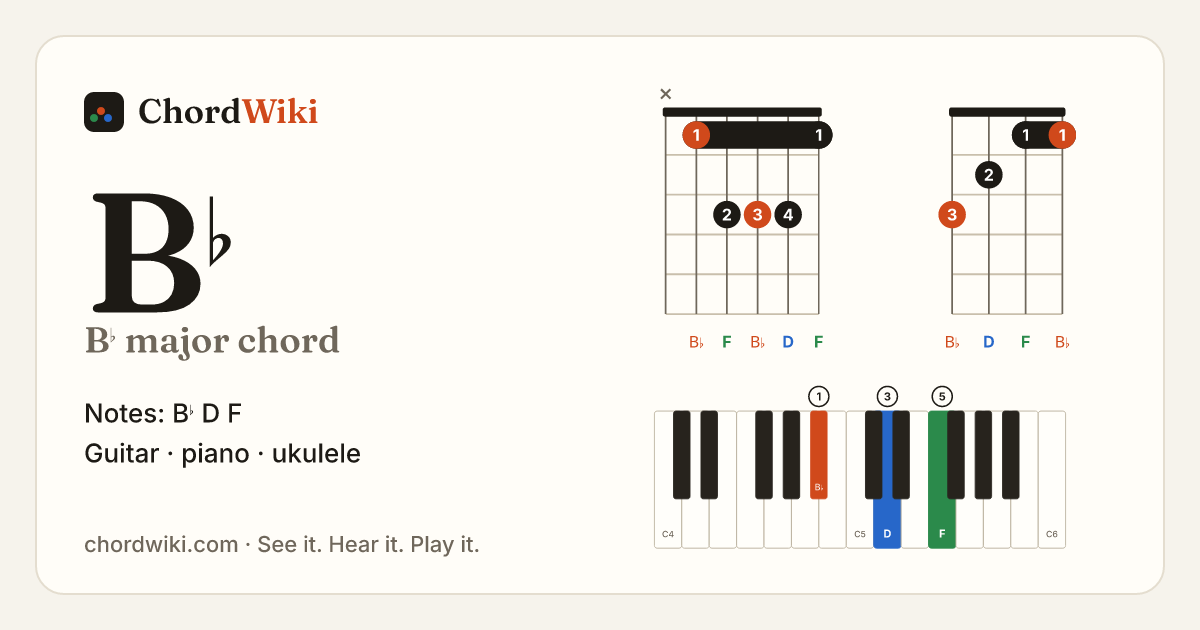
There’s no open-string way to play B♭ on guitar with the root in the bass, so the standard shape is a barre across the 1st fret (x13331).
On piano, B♭ has one black key (B♭) and two white keys.
On ukulele the usual B♭ shape is 3211, with a small 2-string barre at the 1st fret.
Related chords
B♭ shares two of its three notes with Gm (B♭ and D), its relative minor, and with Dm (D and F). That overlap is why these chords sound so natural next to each other — and why they can often stand in for one another.
Move a single note and B♭ becomes a different chord: lower D to D♭ for B♭m, add A♭ for B♭7, add A for B♭maj7 and raise D to E♭ for B♭sus4.
Where you’ll hear it
You’ll find B♭ in common progressions such as B♭–F–Gm–E♭ (the pop progression in B♭ major), B♭–E♭–F–E♭ (three-chord rock in B♭ major) and B♭–Gm–E♭–F (the ’50s progression in B♭ major).