Triads
D major chord
Bright, stable and resolved — the foundation of most songs.
D is the I chord in D major, IV in A major and V in G major. In minor keys: III in B minor, V in G minor, VI in F♯ minor and VII in E minor.
- Notes
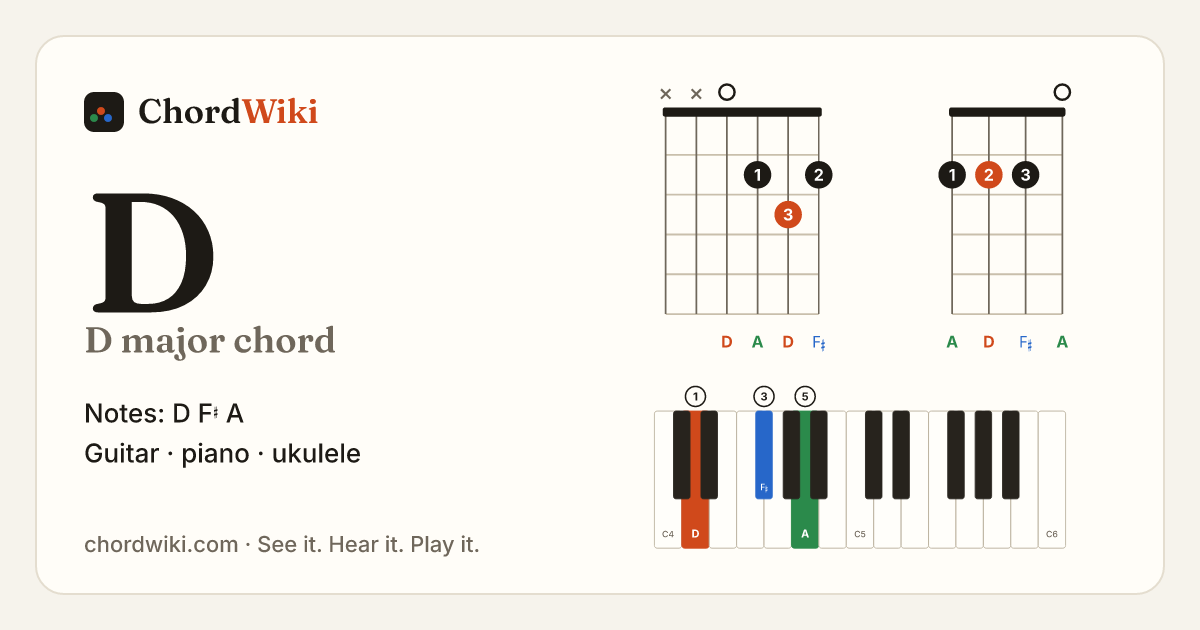
- DF♯A
- Formula
- 135
- Built from
- root · major 3rd · perfect 5th
How to play D
About the D major chord
D major is one of the most natural keys for guitar and fiddle — their open strings ring out in D, giving it a bright, open sound. It’s also the V chord in G major, one of the most common keys in folk, country and bluegrass.
Playing it
On guitar, D has an open-position shape, xx0232, using three fingers alongside the open strings. Don’t strum the low E and A strings.
On piano, D has one black key (F♯) and two white keys.
On ukulele the usual D shape is 2220, using three fingers.
Related chords
D shares two of its three notes with Bm (D and F♯), its relative minor, and with F♯m (F♯ and A). That overlap is why these chords sound so natural next to each other — and why they can often stand in for one another.
Move a single note and D becomes a different chord: lower F♯ to F for Dm, add C for D7, add C♯ for Dmaj7 and raise F♯ to G for Dsus4.