Sevenths
G♭ minor 7th chord
Smooth and soulful; a staple of jazz, R&B and funk.
G♭m7 is the ii7 chord in E major, iii7 in D major and vi7 in A major. In minor keys: i7 in F♯ minor and iv7 in C♯ minor.
- Notes
- G♭B𝄫D♭F♭
- Formula
- 1♭35♭7
- Built from
- root · minor 3rd · perfect 5th · minor 7th
How to play G♭m7
About the G♭ minor 7th chord
Playing it
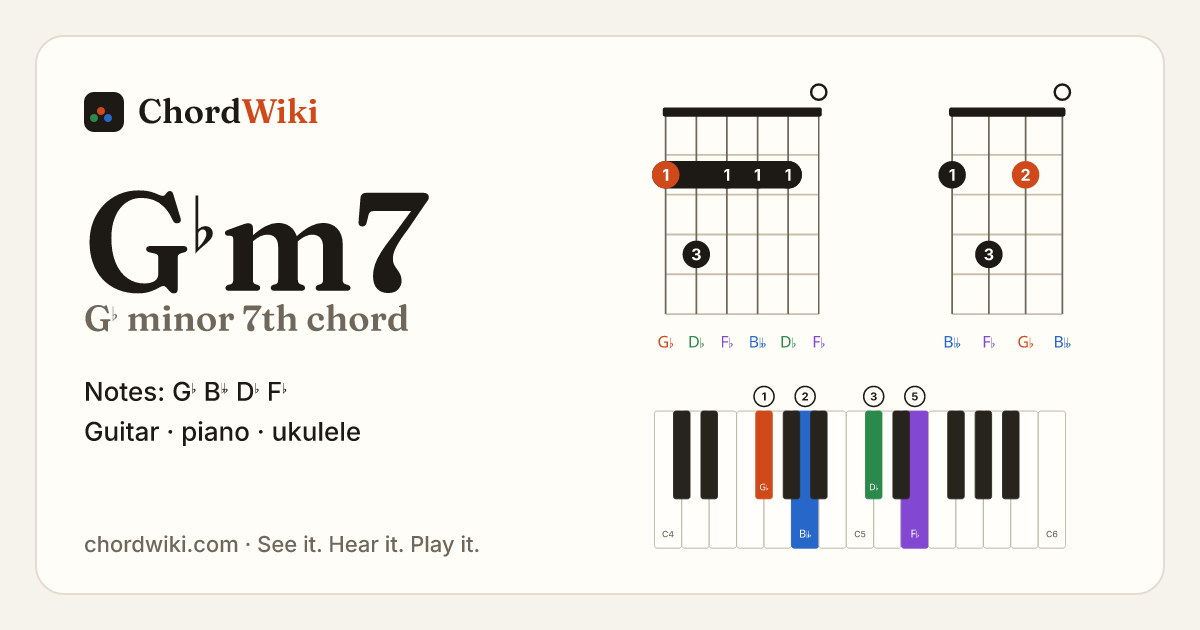
On guitar, G♭m7 is one of the friendlier shapes: 242220 needs just two fingers and lets the open strings ring.
On piano, G♭m7 has two black keys (G♭ and D♭) and two white keys.
On ukulele the usual G♭m7 shape is 2420, using three fingers.
Related chords
Take away the root and the other three notes form B𝄫 (B𝄫 D♭ F♭) — so you can think of G♭m7 as B𝄫 with G♭ added underneath.
G♭m7 contains exactly the same notes as A6. Which name fits depends on which note is in the bass and what key you’re in.
Move a single note and G♭m7 becomes a different chord: drop the F♭ for G♭m, raise B𝄫 to B♭ for G♭7, lower F♭ to E♭ for G♭m6 and swap B𝄫 for C♭ for G♭7sus4.
Where you’ll hear it
You’ll find G♭m7 in common progressions such as F♯m7–B7–Emaj7 (the jazz cadence in E major).
Notice the B𝄫 in G♭m7 (G♭ B𝄫 D♭ F♭): each note of the chord takes its own letter (G–B–D–F), so the minor 3rd has to be written B𝄫 rather than A — the same key on a piano, spelled to fit the chord.