Triads
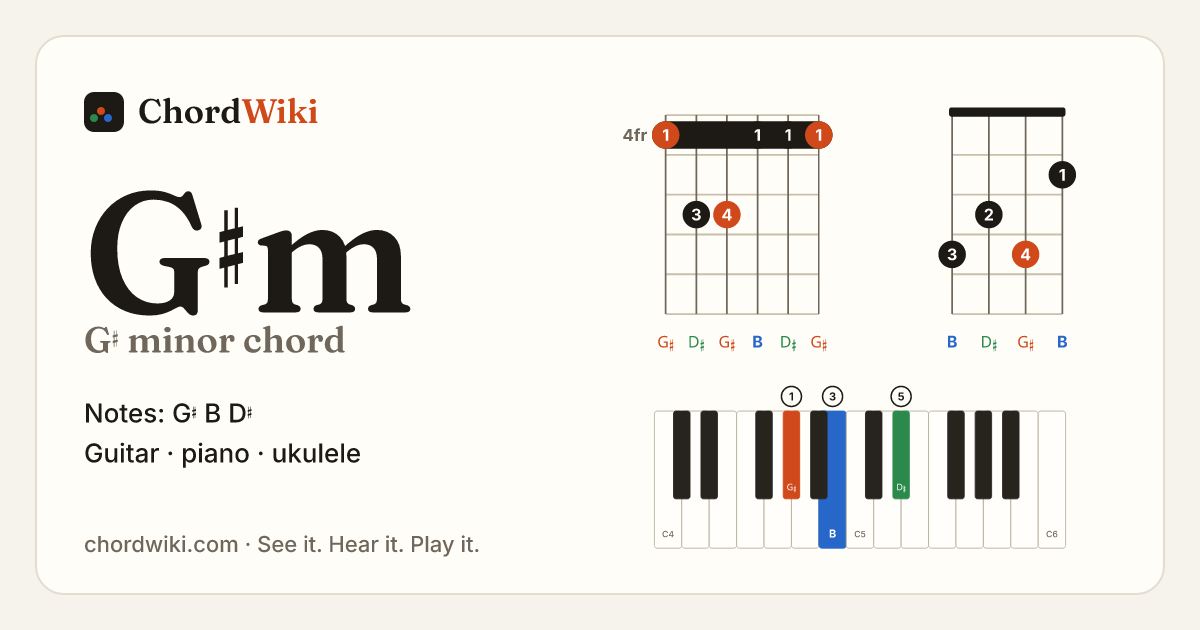
G♯ minor chord
Darker and more melancholy than major, but just as stable.
G♯m is the ii chord in F♯ major, iii in E major and vi in B major. In minor keys: i in G♯ minor and iv in E♭ minor.
- Notes
- G♯BD♯
- Formula
- 1♭35
- Built from
- root · minor 3rd · perfect 5th
How to play G♯m
About the G♯ minor chord
G♯ minor is the relative minor of B major and turns up in songs in E major as the iii chord.
Playing it
On guitar, G♯m is most often played as a barre chord across the 4th fret (466444). While you build strength, you can play just the top four strings of the same shape (xx6444).
On piano, G♯m has two black keys (G♯ and D♯) and one white key.
On ukulele the usual G♯m shape is 4342, using four fingers.
Related chords
G♯m shares two of its three notes with B (B and D♯), its relative major, and with E (G♯ and B). That overlap is why these chords sound so natural next to each other — and why they can often stand in for one another.
Move a single note and G♯m becomes a different chord: raise B to B♯ for G♯, add F♯ for G♯m7, swap B for C♯ for G♯sus4 and lower B to A♯ for G♯sus2.
Where you’ll hear it
You’ll find G♯m in common progressions such as G♯m–E–B–F♯ (the minor-feel pop progression in B major), G♯m–C♯m–D♯–G♯m (the minor cadence in G♯ minor) and G♯m–F♯–E–D♯ (the Andalusian cadence in G♯ minor).