Triads
F minor chord
Darker and more melancholy than major, but just as stable.
Fm is the ii chord in E♭ major, iii in D♭ major and vi in A♭ major. In minor keys: i in F minor and iv in C minor.
- Notes
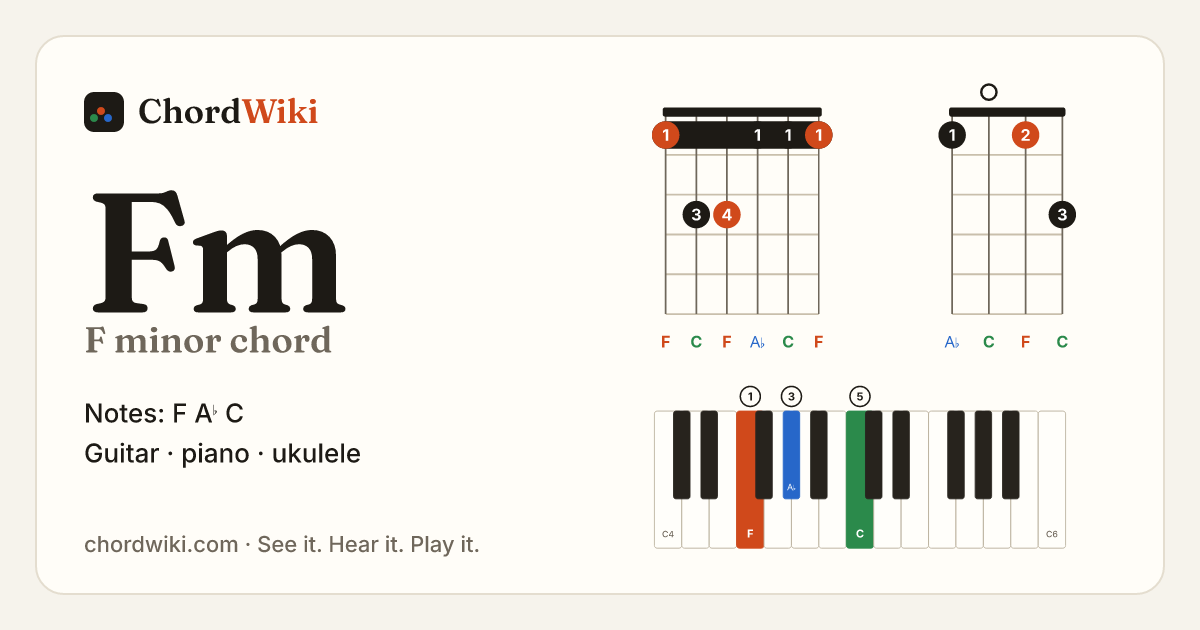
- FA♭C
- Formula
- 1♭35
- Built from
- root · minor 3rd · perfect 5th
How to play Fm
About the F minor chord
F minor is dark and heavy — a favorite key for dramatic piano music. It’s the iv chord in C minor and the relative minor of A♭ major.
Playing it
There’s no open-string way to play Fm on guitar with the root in the bass, so the standard shape is a barre across the 1st fret (133111). While you build strength, you can play just the top four strings of the same shape (xx3111).
On piano, Fm has one black key (A♭) and two white keys.
On ukulele the usual Fm shape is 1013, using three fingers.
Related chords
Fm shares two of its three notes with A♭ (A♭ and C), its relative major, and with D♭ (F and A♭). That overlap is why these chords sound so natural next to each other — and why they can often stand in for one another.
Move a single note and Fm becomes a different chord: raise A♭ to A for F, add E♭ for Fm7, swap A♭ for B♭ for Fsus4 and lower A♭ to G for Fsus2.
Where you’ll hear it
You’ll find Fm in common progressions such as Fm–D♭–A♭–E♭ (the minor-feel pop progression in A♭ major), Fm–B♭m–C–Fm (the minor cadence in F minor) and Fm–E♭–D♭–C (the Andalusian cadence in F minor).